Showing posts with label Social – TechCrunch. Show all posts

Thursday, November 12, 2020

Twitter labeled 300,000 US election tweets — around 0.2%

Just over a week after the U.S. elections, Twitter has offered a breakdown of some of its efforts to label misleading tweets. The site says that from October 27 to November 11, it labeled some 300,000 tweets as part of its Civic Integrity Policy. That amounts to around 0.2% of the total number of election-related tweets sent during that two-week period.

Of course, not all Twitter warnings are created equal. Only 456 of those included a warning that covered the text and limited user engagement, disabling retweets, replies and likes. That specific warning did go a ways toward limited engagement, with around three-fourths of those who encountered the tweets seeing the obscured texts (by clicking through the warning). Quote tweets for those so labeled decreased by around 29%, according to Twitter’s figures.

The president of the United States received a disproportionate number of those labels, as The New York Times notes that just over a third of Trump’s tweets between November 3 and 6 were hit with such a warning. The end of the election (insofar as the election has actually ended, I suppose) appears to have slowed the site’s response time somewhat, though Trump continues to get flagged, as he continues to devote a majority of his feed to disputing the election results confirmed by nearly every major news outlet.

His latest tweet as of this writing has been labeled disputed, but not hidden, as Trump repeats claims against voting machine maker, Dominion. “We also want to be very clear that we do not see our job as done,” Legal, Policy and Trust & Safety Lead Vijaya Gadde and Product Lead Kayvon Beykpour wrote. “Our work here continues and our teams are learning and improving how we address these challenges.”

Twitter and other social media sites were subject to intense scrutiny following the 2016 election for the roles the platforms played in the spread of misinformation. Twitter sought to address the issue by tweaking recommendations and retweets, as well as individually labeling tweets that violate its policies.

Earlier today, YouTube defended its decision to keep controversial election-related videos, noting, “Like other companies, we’re allowing these videos because discussion of election results & the process of counting votes is allowed on YT. These videos are not being surfaced or recommended in any prominent way.”


from Social – TechCrunch https://ift.tt/38Gr8iu

Wednesday, November 11, 2020

Twitter brings its Stories feature, Fleets, to Japan

Twitter’s own version of Stories, which it calls “Fleets,” have arrived in Japan. The new feature allows users to post ephemeral content that automatically disappears after 24 hours. Though Fleets previously launched in Brazil, India, Italy and South Korea, Japan is notably Twitter’s second largest market, with some estimated 51.9 million users.

It’s also second in terms of revenues, led by advertising. In Q3 2020, Japan generated $132.4 million in revenue, coming in second behind the U.S.’s $512.6 million.

Twitter can be experimental when it comes to new features — it even once developed a new way to manage threads with a public prototype, coded alongside user feedback. But not all the features it dabbles with make it to launch.

However, the further expansion of Fleets to Japan signals Twitter’s interest in the product hasn’t diminished over time. It seems it’s now only a matter of time before Fleets arrive in Twitter’s largest market, the U.S.

That said, the U.S. may be the hardest market for Fleets to crack, as here, many users are concerned about how all social media apps are starting to look alike.

Whatever feature becomes a breakout success on one platform soon finds its way to all the others. In the early days, we saw this trend with the “feed” format, modeled after Facebook’s News Feed. The Stories format, popularized by Snapchat, came next. And now apps like Instagram and Snapchat are ripping off TikTok with their own short-form video features.

The result is that apps are losing focus on what makes them unique.

Twitter, for what it’s worth, has historically been slow to copy from other social networks. In fact, it’s one of the last to embrace Stories — a feature that’s now even on LinkedIn, of all places.

Plus, in Twitter’s case, the Stories feature may end up serving a different purpose than on other networks.

Instead of offering users a way to post content of lesser quality — posts that didn’t deserve a more prominent spot in the feed, that is — Fleets may encourage users who haven’t felt comfortable with the platform’s more public nature to begin posting for the first time. Or, at least, it could push users to increase their content output and engagement.

Twitter’s Fleets work much like Stories on other platforms. With a tap on the “+” (plus) button, users can post text, photos, GIFs or videos. Meanwhile, viewers use gestures to navigate the Fleets posted by others. The Stories sit at the top of the app’s home screen, also like on other platforms.

Twitter tells TechCrunch all users in Japan should have Fleets available on their accounts soon, but couldn’t share a time frame for a U.S. launch.


from Social – TechCrunch https://ift.tt/2IiP0OB

Thursday, November 5, 2020

TikTok’s parent company, ByteDance, is reportedly looking for $2B before its Hong Kong public offering

ByteDance, the company behind the social media sensation TikTok, is in talks to raise another $2 billion before the initial public offering of a large chunk of its international businesses on the Hong Kong StockExchange, according to a Bloomberg report.

The new financing would give the Chinese tech powerhouse a valuation of $180 billion, according to people cited by Bloomberg.

Investors, including ByteDance’s existing backers like Sequoia, are in the running to finance the new investment, the Bloomberg report said.

Sequoia had emerged as one of the drivers behind a now-stalled deal touted by the Trump administration to have Oracle take some sort of control over the American operations of ByteDance’s most valuable international asset — TikTok.

Both Sequoia and Oracle have significant ties to President Trump through Republican mega-donors Doug Leone, a managing partner at Sequoia, and Safra Catz and Larry Ellison, Oracle’s top leadership and founder.

ByteDance has long planned a public offering for some of its largest Asian assets Douyin and Toutiao, which are huge drivers for the company’s revenues.

TechCrunch previously reported that ByteDance last year generated 120 billion yuan ($17.2 billion) in revenue, citing an investor with knowledge of the company’s finances. Around 67% of that revenue was derived from ads sold on its domestic apps Douyin, TikTok’s Chinese version, and popular news aggregator Toutiao. Live streaming targeted at users of Douyin and another app in the family made up about 17%. Nascent businesses, including games, e-commerce and TikTok, accounted for 20 billion yuan, or roughly another 17%.

The company projected its 2020 revenue at 200 billion yuan ($28.7 billion), with TikTok and other emerging businesses contributing 30 billion yuan, or 15%, according to the investor. Previous reports by Reuters and Bloomberg cited similar revenue figures.

ByteDance is already the most valuable privately held, venture-backed technology company in the world, but at least some of that value is tied up in the revenue-generating potential of the company’s TikTok assets. And it appears that any new investment (at the valuations being reported) would be an indication that investors are shrugging off previous concerns about how a TikTok spin-off might affect the company.

Much of what happens next will hinge on the presidential elections in the U.S. and various court battles that remain underway. A Biden administration could scuttle the planned deal between TikTok, Oracle and Walmart — and a timeline for a separate TikTok public offering within the U.S.

There’s also internal confusion among the TikTok deal’s participants over who will own what when the dust finally settles and a deal moves forward.

As we reported in September:

… our assumption, that Oracle is taking 12.5% in TikTok Global, and Walmart will take 7.5%. The deal terms would value TikTok at about $60 billion by some estimates.

That’s a simple story, but apparently not the full one, because now there is another wrinkle happening here.

In a new statement attributed to its executive vice president Ken Glueck, Oracle said that “Upon creation of TikTok Global, Oracle/Walmart will make their investment and the TikTok Global shares will be distributed to their owners, Americans will be the majority and ByteDance will have no ownership in TikTok Global.”

President Donald Trump has spoken out about the deal himself in places like CNBC, arguing that TikTok must be completely controlled by Americans.

The U.S. government’s trouble with TikTok stems from a few different sources. For one, users on the platform managed to troll a deeply vindictive president and turn one of his planned marquee campaign events into a farce. And more importantly to the nation, but apparently less so to the administration, the company’s ties to China could expose U.S. citizens’ data to the CCP and its users to the potential for manipulation through TikTok’s decisions on what to post or not post on the app.

Sequoia and ByteDance had not responded to a request for comment at the time of publication.


from Social – TechCrunch https://ift.tt/3618Xkw

Friday, October 30, 2020

Facebook hits pause on algorithmic recommendations for political and social issue groups

With just days to go before the U.S. election, Facebook quietly suspended one of its most worrisome features.

During Wednesday’s Senate hearing, Senator Ed Markey asked Facebook CEO Mark Zuckerberg about reports that his company has long known its group recommendations push people toward more extreme content. Zuckerberg responded that the company had actually disabled that feature for certain groups — a fact Facebook had not previously announced.

“Senator, we have taken the step of stopping recommendations in groups for all political content or social issue groups as a precaution for this,” Zuckerberg told Markey.

TechCrunch reached out to Facebook with questions about what kind of groups would be affected and how long the recommendations would be suspended at the time but did not receive an immediate response. Facebook first confirmed the change to BuzzFeed News on Friday.

“This is a measure we put in place in the lead up to Election Day,” Facebook spokesperson Liz Bourgeois told TechCrunch in an email. “We will assess when to lift them afterwards, but they are temporary.”

The cautionary step will disable recommendations for political and social issue groups as well as any new groups that are created during the window of time. Facebook declined to provide additional details about the kinds of groups that will and won’t be affected by the change or what went into the decision.

Researchers who focus on extremism have long been concerned that algorithmic recommendations on social networks push people toward more extreme content. Facebook has been aware of this phenomenon since at least 2016, when an internal presentation on extremism in Germany observed that “64% of all extremist group joins are due to our recommendation tools.” In light of the feature’s track record, some anti-hate groups celebrated Facebook’s decision to hit the pause button Friday.

“It’s good news that Facebook is disabling group recommendations for all political content or social issue groups as a precaution during this election season. I believe it could result in a safer experience for users in this critical time,” Anti-Defamation League CEO Jonathan A. Greenblatt told TechCrunch. “And yet, beyond the next week, much more needs to be done in the long term to ensure that users are not being exposed to extremist ideologies on Facebook’s platforms.”

On Facebook, algorithmic recommendations can usher users flirting with extreme views and violent ideas into social groups where their dangerous ideologies can be amplified and organized. Before being banned by the social network, the violent far-right group the Proud Boys relied on Facebook groups for its relatively sophisticated national recruitment operation. Members of the group that plotted to kidnap Michigan Governor Gretchen Whitmer also used Facebook groups to organize, according to an FBI affidavit.

While it sounds like Facebook’s decision to toggle off some group recommendations is temporary, the company has made an unprecedented flurry of choices to limit dangerous content in recent months, possibly in fear that the 2020 election will again plunge it into political controversy. Over the last three months alone, Facebook has cracked down on QAnon, militias and language used by the Trump campaign that could result in voter intimidation — all surprising postures considering its longstanding inaction and deep fear of decisions that could be perceived as partisan.

After years of relative inaction, the company now appears to be taking seriously some of the extremism it has long incubated, though the coming days are likely to put its new set of protective policies to the test.


from Social – TechCrunch https://ift.tt/3mzE5OX

Thursday, October 29, 2020

WhatsApp is now delivering roughly 100 billion messages a day

WhatsApp, the popular instant messaging app owned by Facebook, is now delivering roughly 100 billion messages a day, the company’s chief executive Mark Zuckerberg said at the quarterly earnings call Thursday.

For some perspective, users exchanged 100 billion messages on WhatsApp last New Year’s Eve. That is the day when WhatsApp tops its engagement figures, and as many of you may remember, also the time when the service customarily suffered glitches in the past years. (No outage on last New Year’s Eve!)

At this point, WhatsApp is just competing with itself. Facebook Messenger and WhatsApp together were used to exchange 60 billion messages a day as of early 2016. Apple chief executive Tim Cook said in May that iMessage and FaceTime were seeing record usage, but did not share specific figures. The last time Apple did share the figure, it was far behind WhatsApp’s then usage (podcast). WeChat, which has also amassed over 1 billion users, is behind in daily volume of messages, too.

In early 2014, WhatsApp was being used to exchange about 50 billion texts a day, its then chief executive Jan Koum revealed at an event.

At the time, WhatsApp had fewer than 500 million users. WhatsApp now has more than 2 billion users and at least in India, its largest market by users, its popularity surpasses those of every other smartphone app including the big blue app.

“This year we’ve all relied on messaging more than ever to keep up with our loved ones and get business done,” tweeted Will Cathcart, head of WhatsApp.

Sadly, that’s all the update the company shared on WhatsApp today. Mystery continues for when WhatsApp expects to resume its payments service in Brazil, and when it plans to launch its payments in India, where it began testing the service in 2018. (It has already shared big plans around financial services in India, though.)

“We are proud that WhatsApp is able to deliver roughly 100B messages every day and we’re excited about the road ahead,” said Cathcart.


from Social – TechCrunch https://ift.tt/3my12C2

Ad revenues and e-commerce boom boost Facebook earnings but US users down from COVID surge

Facebook reported its Q3 earnings today, including revenues of $21.5 billion, and net income of $7.8 billion. The company earned $2.71 in per-share profit during the three-month period.

Analysts had expected Facebook, the social giant, to earn a much-smaller $1.91 per-share off smaller revenues of $19.82 billion. The company also reported an average of 1.82 billion daily active users in September, up 12% compared to the year-ago period. Monthly actives were 2.74 billion, also up 12%. Both results were ahead of expectations.

Notably Facebook’s headcount rose sharply during the year, rising 32% compared to the year-ago period. That outstripped its 22% year-over-year revenue growth. The company’s total expenses rose 28%, again faster than its revenues.

Shares of Facebook are effectively flat in after-hours trading, up around 0.4% at the time of writing.

The company did not share a specific outlook for Q4 2020 or 2021 in its report, instead noting that it anticipates “fourth quarter 2020 year-over-year ad revenue growth rate to be higher than [its] reported third quarter 2020 rate,” along with stronger non-advertising revenues stemming from Oculus Quest 2 sales, the company’s new VR helmet.

Facebook did say that 2021 will bring a “significant amount of uncertainty.” A potential hurdle of Facebook will be the regulatory environment in Europe, and viability of transatlantic data transfers. Facebook says that its “closely monitoring the potential impact on our European operations as these developments’ progress.”

Analysts expect Facebook to generate revenues of $24.25 billion and per-share profit of $2.67 in the fourth quarter of 2020, and $100.0 billion in 2021 top line leading to $10.26 in per-share income.

What matters in all of this? That the core advertising market that seemed to bolster Snap’s own results has helped fill Facebook’s wings as well. Facebook noted in its earnings that it thinks that the “pandemic has contributed to an acceleration in the shift of commerce from offline to online,” leading to it experiencing “increasing demand for advertising as a result of this acceleration.” Twitter, meanwhile, saw ad revenue only marginally increase, about 8% from the year prior, as advertiser taste buds remain volatile.

That’s a tailwind from a secular shift. For Facebook, it could mean a good year’s growth.

It’s worth noting, however, that Facebook lost users in the U.S. and Canada — down to 196 million from 198 million last quarter — a decline that it attributed to a slowing surge from the abnormal highs seen in the midst of the lockdowns associated with the COVID-19 pandemic. So tailwinds, but also a return to normal patterns. And it expects this flat or down trend to continue into Q3, noting that “in the fourth quarter of 2020, we expect this trend to continue and that the number of DAUs and MAUs in the US & Canada will be flat or slightly down compared to the third quarter of 2020.”


from Social – TechCrunch https://ift.tt/3kEIFe4

Wednesday, October 7, 2020

Facebook: Trump can’t recruit ‘army’ of poll watchers under new voter intimidation rules

In a blog post Wednesday, Facebook said it will no longer allow content that encourages poll watching that uses “militarized” language or intends to “intimidate, exert control, or display power over election officials or voters.” Facebook credited the update to its platform rules to civil rights experts who it worked with to create the policy.

Facebook Vice President of Content Policy Monika Bickert elaborated on the new rules in a call with reporters, noting that wording would prohibit posts that use words like “army” or “battle” — a choice that appears to take direct aim at the Trump campaign’s effort to recruit an “army for Trump” to watch the polls on election day. Last month, Donald Trump Jr. called for supporters to “enlist now” in an “army for Trump election security operation” in a video that was posted on Facebook and other social platforms.

“Under the new policy if that video were to be posted again, we would indeed remove it,” Bickert said.

The company says that while posts calling for “coordinated interference” or showing up armed at polling places are already targeted for removal, the expanded policy will more fully address voter intimidation concerns. Facebook will apply the expanded policy going forward but it won’t affect content already on the platform, including the Trump Jr. post.

Poll watching to ensure fair elections is a regular part of the process, but weaponizing those observers to seek evidence for unfounded claims about “fraudulent ballots” and a “rigged” election is something new — and something more akin to voter intimidation. Poll watching laws vary by state and some states limit how many poll watchers can be present and how they must identify themselves.

Trump has repeatedly failed to say he will accept the election results in the event that he loses, a position that poses an unprecedented threat to the peaceful transition of power in the U.S. That concern is one of many that social media companies and voting rights advocates are anxiously keeping an eye on as election day nears.

“Donald Trump is not interested in election integrity, he’s interested in voter suppression,” VoteAmerica Founder Debra Cleaver said of the Trump campaign’s poll watching efforts. “Sending armed vigilantes to the polls is a solution to a problem that doesn’t exist, unless you believe that Black and Brown people voting is a problem.”

Facebook is also making some changes to its rules around political advertising. The company will no longer allow political ads immediately following the election in an effort to avoid chaos and false claims.

“… While ads are an important way to express voice, we plan to temporarily stop running all social issue, electoral, or political ads in the U.S. after the polls close on November 3, to reduce opportunities for confusion or abuse,” Facebook Vice President of Integrity Guy Rosen wrote in a blog post. Rosen added that Facebook will let advertisers know when those ads are allowed again.

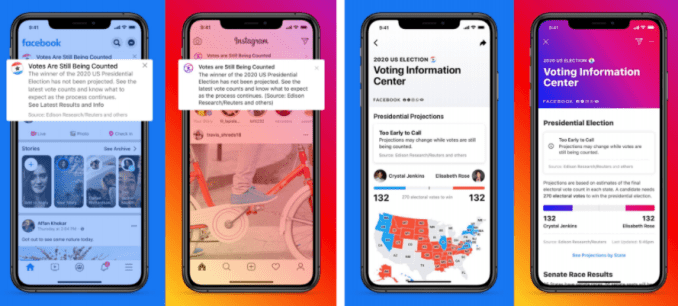
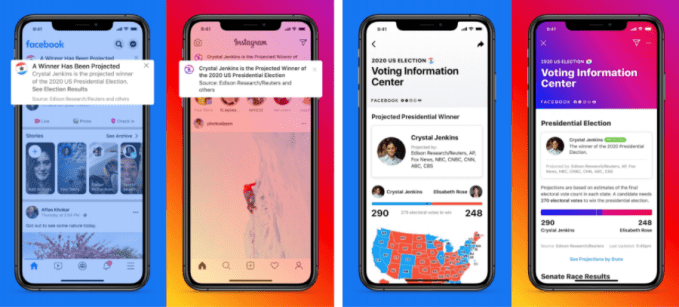
Facebook also provided a glimpse of what its apps will look like on what might shape up to be an unusual election night. The company will place a notification at the top of the Instagram and Facebook apps with the status of the election in an effort to broadly fact-check false claims.

Facebook election night messages

Facebook election night messages

Images via Facebook

Those messages will remind users that “Votes are still being counted” before switching over to a message that “A winner has been projected” after a reliable consensus emerges about the race. Because the results of the election may not be apparent on election night this year, it’s possible that users will see these messages beyond November 3. If a candidate declares a premature victory, Facebook will add one of these labels to that content.

Facebook also noted that it is now using a viral content review system, a measure designed to prevent the many instances in which misinformation or otherwise harmful content racks up thousands of views before eventually being removed. Facebook says the tool, which it says it has relied on “throughout election season,” provides a safety net that helps the company detect content that breaks its rules so it can take action to limit its spread.

In the final month before the election, Facebook is notably showing less hesitation toward policing misinformation and other harmful political content on its platform. The company announced Tuesday that it would no longer allow the pro-Trump conspiracy theory known as QAnon to flourish there, as it has over the last four years. Facebook also removed a post this week in which President Trump, fresh out of a multi-day hospital stay, claimed that COVID-19 is “far less lethal” than the flu.


from Social – TechCrunch https://ift.tt/3jRNyzW

Tuesday, October 6, 2020

Twitter tests a new way to find accounts to follow

Twitter is testing a new way to follow accounts. The company announced today it’s rolling out a new feature, “Suggested Follows,” that will pop up a list of other accounts you may want to follow on the profile page of someone you had just followed. The feature will be tested on Android devices, for the time being.

The feature offers a tweak to how following currently works on mobile. At present, when you tap “Follow” on a user’s profile page, you’re presented with a small list of suggested accounts you may also want to follow.

Twitter explains that its accounts suggestions are based on a number of factors, and are often personalized. But in the case of suggested follows, it uses algorithms to determine what accounts may be related to the profile you’ve just visited, or if people who follow that user tend to follow certain other users.

That’s why, for example, when you follow someone whose profiles notes they work at a particular company, the Suggested follows may then include others who also work there. Or why when you follow a celebrity of some sort, you may be presented with other high-profile accounts as suggestions.

Before, however, you would have to tap on the suggestions one by one if you wanted to follow them. Twitter’s new test instead, groups a larger number of suggestions that you can follow with just one tap. You can then opt to remove those accounts you may not want to follow after first adding the full group.

This could make it easier for users to gain follows, if their account is related somehow to another account that’s seeing a high number of follows. It could also help Twitter newcomers build out their networks, while helping existing users expand their own.

Some Twitter users may have already seen the feature in action, before today.

Twitter says the test is taking place on Android. The company didn’t note if or when the feature would expand to iOS.


from Social – TechCrunch https://ift.tt/2HWdMTW

Friday, October 2, 2020

Twitter will make users remove tweets hoping Trump dies of COVID-19

President Donald Trump’s positive COVID-19 result has made Twitter a busy place in the past 24 hours, including some tweets that have publicly wished — some subtly and others more directly — that he die from the disease caused by coronavirus.

Twitter put out a reminder to folks that it doesn’t allow tweets that wish or hope for death or serious bodily harm or fatal disease against anyone. Tweets that violate this policy will need to be removed, Twitter said Friday. However, it also clarified that this does not automatically mean suspension. Several new outlets misreported that users would be suspended automatically. Of course, that doesn’t mean users won’t be suspended.

On Thursday evening, Trump tweeted that he and his wife and First Lady Melania Trump had tested positive for COVID-19. White House physician Sean Conley issued a memo Friday confirming the positive results of SAR-Cov-2 virus, which often more commonly known as COVID-19.  Trump was seen boarding a helicopter Friday evening that was bound for Walter Reed Medical Center for several days of treatment.

The diagnosis sent shares tumbling Friday on the key exchanges, including Nasdaq. The news put downward pressure on all major American indices, but heaviest on tech shares.


from Social – TechCrunch https://ift.tt/3l3xEmg

Thursday, October 1, 2020

Facebook sues two companies engaged in data scraping operations

Facebook today says it has filed a lawsuit in the U.S. against two companies that had engaged in an international “data scraping” operation. The operation extended across Facebook properties, including both Facebook and Instagram, as well as other large websites and services, including Twitter, Amazon, LinkedIn and YouTube. The companies, which gathered the data of Facebook users for “marketing intelligence” purposes, did so in violation of Facebook’s Terms of Service, says Facebook.

The businesses named in the lawsuit are Israeli-based BrandTotal Ltd. and Unimania Inc., a business incorporated in Delaware.

According to BrandTotal’s website, its company offers a real-time competitive intelligence platform that’s designed to give media, insights and analytics teams visibility into their competition’s social media strategy and paid campaigns. These insights would allow its customers to analyze and shift their budget allocation to target new opportunities, monitor trends and threats from emerging brands, optimize their ads and messaging and more.

Meanwhile, Unimania operated apps claimed to offer users the ability to access social networks in different ways. For example, Unimania offered apps that let you view Facebook via a mobile-web interface or alongside other social networks like Twitter. Another app let you view Instagram Stories anonymously, it claimed.

However, Facebook’s lawsuit is largely focused on two browser extensions offered by the companies: Unimania’s “Ads Feed” and BrandTotal’s “UpVoice.”

The former allowed users to save the ads they saw on Facebook for later reference. But as the extension’s page discloses, doing so would opt users into a panel that informed the advertising decisions of Unimania’s corporate customers. UpVote, on the other hand, rewarded users with gift cards for using top social networking and shopping sites and sharing their opinions about the online campaigns run by big brands.

Facebook says these extensions operated in violation of its protections against scraping and its terms of service. When users installed the extensions and visited Facebook websites, the extensions installed automated programs to scrape their name, user ID, gender, date of birth, relationship status, location information and other information related to their accounts. The data was then sent to a server shared by BrandTotal and Unimania.

Facebook lawsuit vs BrandTotal Ltd. and Unimania Inc. by TechCrunch on Scribd

Data scrapers exist in part to collect as much information as they can through any means possible using automated tools, like bots and scripts. Cambridge Analytica infamously scraped millions of Facebook profiles in the run-up to the 2016 presidential election in order to target undecided voters. Other data scraping operations use bots to monitor concert or event ticket prices in order to undercut competitors. Scraped data can also be used for marketing and advertising, or simply sold on to others.

In the wake of the Cambridge Analytica scandal, Facebook has begun to pursue legal action against various developers that break its terms of service.

Most cases involving data scraping are litigated under the Computer Fraud and Abuse Act, written in the 1980s to prosecute computer hacking cases. Anyone who accesses a computer “without authorization” can face hefty fines or even prison time.

But because the law doesn’t specifically define what “authorized” access is and what isn’t, tech giants have seen mixed results in their efforts to shut down data scrapers.

LinkedIn lost its high-profile case against HiQ Labs in 2019 after an appeals court ruled that the scraper was only collecting data that was publicly available from the internet. Internet rights groups like the Electronic Frontier Foundation lauded the decision, arguing that internet users should not face legal threats “simply for accessing publicly available information in a way that publishers object to.”

Facebook’s latest legal case is slightly different because the company is accusing BrandTotal of scraping Facebook profile data that wasn’t inherently public. Facebook says the accused data scraper used a browser extension installed on users’ computers to gain access to their Facebook profile data.

In March 2019, it took action against two Ukrainian developers who were harvesting data using quiz apps and browser extensions to scrape profile information and people’s friends lists, Facebook says. A court in California recently recommended a judgement in Facebook’s favor in the case. A separate case around scraping filed last year against a marketing partner, Stackla, also came back in Facebook’s favor.

This year, Facebook filed lawsuits against companies and individuals engaged in both scraping and fake engagement services.

Facebook isn’t just cracking down on data scraping businesses to protect user privacy, however. It’s because failing to do so can lead to large fines. Facebook at the beginning of this year was ordered to pay out over half a billion dollars to settle a class action lawsuit that alleged systemic violation of an Illinois privacy law. Last year, it settled with the FTC over privacy lapses and had to pay a $5 billion penalty. As governments work to further regulation of online privacy and data violations, fines like this could add up.

The company says legal action isn’t the only way it’s working to stop data scraping. It has also invested in technical teams and tools to monitor and detect suspicious activity and the use of unauthorized automation for scraping, it says.


from Social – TechCrunch https://ift.tt/36oJZO7

Facebook won’t accept ads that ‘delegitimize’ US election results

Following a particularly dark and vivid display of the threats to the 2020 U.S. election during Tuesday’s first presidential debate, Facebook has further clarified its new rules around election-related ads.

Facebook is now expanding its political advertising rules to disallow any ads that “[seek] to delegitimize the outcome of an election” including “calling a method of voting inherently fraudulent or corrupt, or using isolated incidents of voter fraud to delegitimize the result of an election.”

Facebook Director of Product Management Rob Leathern, who leads the company’s business integrity team, announced the changes on Twitter.

Facebook says it will also not allow ads that discourage users from voting, undermine vote-by-mail or other lawful voting methods, suggest voter fraud is widespread, threaten safe voting through false health claims and ads that suggest the vote is invalid because results might not be immediately known on election night.

Both Twitter and Facebook recently issued new guidelines on how they will handle claims of election victory prior to official results, though Facebook’s rules appear to only apply to those claims if they’re made in advertising. We’ve asked Facebook for clarification about how those claims will be handled outside of ads, on a candidate’s normal account.

While Twitter opted to no longer accept political advertising across the board, Facebook is instead tweaking its rules about what kinds of political ads it will allow and when. Facebook previously announced that it would no longer accept ads about elections, social issues or politics in the U.S. after October 27, though political ads that ran before that date will be allowed to continue.

Facebook is already grappling with a deluge of attacks on the integrity of November’s U.S. election originating with President Trump and his supporters. During Tuesday night’s debate, Trump again cast doubt about voting by mail (a system already trusted and in use nationwide in the form of absentee ballots) and declined to commit to accepting election results if he loses.

While the unique circumstances of the pandemic are leading to logistical challenges, voting through the mail is not new. A handful of states, including Colorado and Oregon, already conducted elections through the mail, and vote-by-mail is just a scaled-up version of the absentee voting systems already in place nationwide.

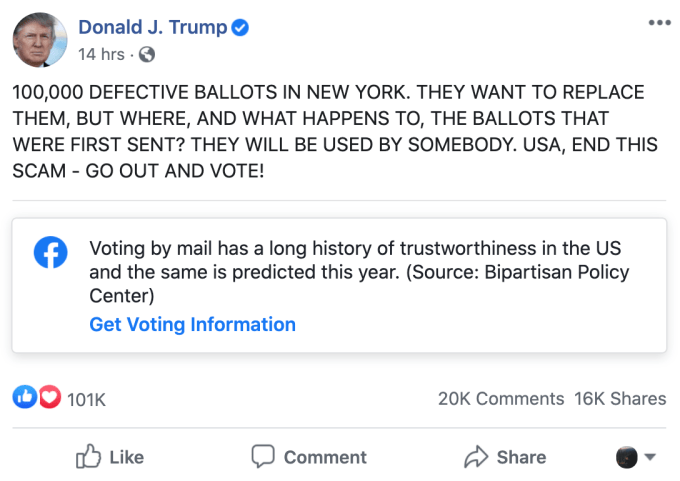
On Wednesday, President Trump sowed conspiratorial ideas about defective ballots that were sent out in New York state as a result of vendor error. The state will reissue the ballots, but Trump seized on the incident as evidence that vote-by-mail is a “scam” — a claim that evidence does not bear out.

Trump’s attacks on the U.S. election are an unprecedented challenge for social platforms, but also one for the nation as a whole, which has never in modern times seen the peaceful transfer of executive power threatened by a sitting president.


from Social – TechCrunch https://ift.tt/3imyXuQ

Friday, September 11, 2020

As COVID-19 era drags on, VCs look beyond Zoom calls for due diligence and sourcing

While the coronavirus has accelerated the dealmaking pace for many early-stage startups, activity has not come without adaptation.

Remote investment struggles for investors were clear from the get go: it’s challenging to invest millions in someone you have never met, and there’s not a lot to learn from “off-the-cuff” conversations that are calendared days in advance. Some investors said the pandemic was forcing them to stick with people they know in categories where they have experience, limiting the network that one can push money into.

Over six months into a global pandemic, though, new techniques are emerging to address some of these woes. The very art of a deal, from due diligence to sourcing, is changing from a cultural and technological standpoint.

One of the new places that recreates informal bonding and camaraderie is Matchbox.VC, formerly Fortnite.VC.

The service connects founders and investors over video games to network and source deals in a low-stress environment. Matchbox.VC was inspired from a tweet by Founders Fund principal Delian Asparouhov and has garnered interest from investors like Arjun Sethi from Tribe Capital, Ryan Shea, the ex-founder of Blockstack, Jake Chapman from AlphafundVC and Peter Rojas from Betaworks. Its last game night was backed by Yac, Tribe Capital and Shrug Capital.

The pitch is simple: founders and investors sign up on the website, answer basic questions about their focus, company and stage before picking three game choices from eight options that include Fortnite, COD: Warzone and Valorant.


from Social – TechCrunch https://ift.tt/2ZvH163

China may kill TikTok’s US operations rather than see them sold

The controversial push to force Chinese tech unicorn ByteDance to divest part or all of its smash-hit TikTok social media service to a U.S.-based company could be in doubt after a report today indicated that China’s government may oppose the transaction. According to reporting by Reuters, the Chinese government may prefer TikTok to simply shutter its U.S. operations instead of allowing it to be sold to an American company.

The potential divestment of TikTok is not a regular business transaction. Instead, the deal is being demanded by the U.S. government, as President Donald Trump directs foreign and economic policymaking via executive fiat. Leaning on his own fabled business acumen, the American premier has also demanded that his government receive a portion of any final sale price. It is not clear if that concept is legal.

As the U.S. and China spar around the globe for both economic and political supremacy, the deal is a flashpoint between the countries with a muddle of companies stuck in the middle. ByteDance is in the mix, along with Microsoft, Walmart and other companies to a lesser degree, like Oracle. The Trump administration has set a mid-September timeline for a deal being struck, though as the month burns away it is not clear if that timeline could be met.

The United States is not alone in taking steps to curb Chinese influence inside its borders, as the TikTok sale comes after India banned the app, along with dozens of other China-based applications.

The deal is also under pressure from a changing regulatory environment in China, with the country’s autocratic leadership changing its export rules to possibly include elements of TikTok that could limit a transaction, and perhaps scuttle its sale.

For ByteDance, the situation is a nightmare. For lead-suitor Microsoft, the transaction is a shotgun marriage that it might not be entirely enthused about. For the Trump administration, it’s an attempt at a power play. And for China’s increasingly authoritarian government, the deal could feel like submission. So, if the deal does manage to come together it will be more surprise than eventuality.


from Social – TechCrunch https://ift.tt/33krYgD

Tuesday, August 25, 2020

Max Schrems on the EU court ruling that could cut Facebook in two

Last month’s ruling by the Court of Justice of the European Union (CJEU), ripping up the EU-US Privacy Shield and sewing doubt over alternative mechanisms, has put a cat among the pigeons of international data transfers.

For Facebook the impact could fall like a cleaving sword as its business is front and center following the so-called Schrems II judgement.

Eponymous privacy campaigner Max Schrems’ underlying complaint targeted the tech giant’s use of a data transfer tool known as Standard Contractual Clauses (SCCs). Thousands of businesses make use of SCCs to carry out EU to US transfers of personal data, sometimes in addition to the now defunct Privacy Shield framework. An earlier ruling by the CJEU — following another Schrems complaint which also drew on the 2013 Snowden disclosures of US government mass surveillance programs — struck down the prior transatlantic ‘Safe Harbor’ arrangement.

SCCs were an existing alternative for businesses to plug the gap then until Privacy Shield came into effect. But the CJEU ruling of no US adequacy with EU privacy standards casts doubt on their continued use for these transfers. Facebook was using SCCs in the Safe Harbor era. Now, in the wake of the CJEU decision, it’s said it’s moving its Privacy Shield transfers to SCCs. So the tech giant has no visible ‘plan B’ if it’s ordered to suspend these data flows too.

In Schrems’ views the only way Facebook will be able to comply with the CJEU ruling is if it splits its infrastructure into two. And while other types of companies — such as cloud storage providers — may already separate data by regions owing to factors like latency or even cost, Facebook’s business simply doesn’t operate like that. It’s designed to draws data to its center.

“Facebook is probably the most [susceptible] to all of this,” says Schrems, discussing the ramifications of the CJEU ruling in an interview with TechCrunch. “For Facebook it’s really, really complicated as a company to comply with any of this.”

“There are parts that are necessary data transfers, and [Facebook] can continue to do that. So basically the message that I sent to an American friend, stuff like that. But that’s only a small percentage,” he continues. “So I think technically the approach they’d have to do is basically split Facebook in two. And then kind of reconnect the necessary data transfers. So you’ve basically federated. A bit like Diaspora was always designed to be; a federated social network where you basically have different parts and what’s necessary is communicated and what’s not necessary is not communicated.”

“They’re not going to do that without heaven and hell moving onto them,” he adds. “I guess — especially for Facebook — that the problem is we kind of have a case where the consequences are so extreme the pushback is obviously as extreme as possible… They know that without fundamentally restructuring the whole system they will never be able to comply with any of this — so they don’t.”

Schrems points to what happened historically with SWIFT financial data exchanges as a comparable scenario — where the fix was to move backups from the US to Switzerland “so only the data that is international and US is actually stored in the US and all the other transfer data is kept in Belgium and Switzerland”. “So you separate your backups and your situations and so on,” he says, adding: “It’s a lot of engineering.”

At this point most of the big tech companies have data centers in Europe. While newer social video sharing app TikTok recently announced plans to establish one Ireland for EU users’ data. But Schrems reckons there’s no easy way for Facebook to unpick all its EU data flows.

We asked Facebook for details on its legal basis for continuing to use SCCs but the company did not engage with questions on the topic. Nor did it respond when we asked for clarity on any ‘plan B’ if it’s ordered to stop using SCCs.

Beyond a massive engineering headache for the company, Schrems doesn’t see huge legal significance in a federated version of Facebook’s service that holds EU users’ data in Europe. But he argues such a split would send an important message about the rule of law.

“The law doesn’t differentiate if the data is processed in Europe or in the US on having to be compliant with it… So I don’t really think we can probably gain much from it. To me it’s more of a general question of companies having to respect the law or just getting away with it, over and over again, without really complying. I don’t think [it would be a gain] for direct compliance — it’s probably more of a big message that you don’t get away with it that would be important to send,” he says.

Can SCCs still be used for US transfers?

In the clash between EU privacy rights and US surveillance law, Europe’s highest court has made it clear it isn’t budging. At the same time, lawyers all over the region are busy grappling with the apparent contradiction of the CJEU finding US surveillance practices fatal to Privacy Shield yet not putting an indelible blocker on SCCs for data transfers over the pond. This other long-standing transfer mechanism — sometimes also referred to as ‘model clauses’ — could have been struck down too but wasn’t. So the court left the door ajar.

Law firms have seized on that to shape strategies for businesses to proceed using SCCs for US data transfers in a way that minimizes their risk — via performing detailed risk assessments and/or applying ‘special measures’, where possible. Given the rich seam of paid advice opportunities opening up it’s not hard to find European lawyers who believe SCCs can be made to work for some data controllers who want to continue (or start) bulk processing EU users’ data in the US.

This advice boils down to handling all of the associated bureaucracy around performing risk assessments over a particular data transfer and whether/how it falls under US surveillance law; for some it may also mean investigating technical and operational solutions, such as whether data could be encrypted in transit and the keys held by a EU entity that’s not subject to US law; and perhaps seeing whether policies can be applied and contractual language beefed up so that a US receiving entity which gets a law enforcement request for data is obliged to take steps to make sure there’s a real legal compulsion underpinning it.

In a public discussion on the topic hosted by the International Association of Privacy Professionals last month, Hogan Lovells partner, Eduardo Ustaran — one of the more bullish voices touting the ongoing value of SCCs for US transfers — made the case for building policy protections into contracts to require a level of push back and interrogation of US government agency requests for data.

“When the court talked about additional safeguards and making up for the lack of protection in the regime of the recipients… they’re talking about precisely that: Having that legal process in place — a contractual obligation — to question that request. And you will probably find that if that is in place only a very, very, very small minority of cases will lead to something that is a true conflict where the prohibition of data really needs to be given,” he argued.

“Even in that case, one needs to question whether that is actually within the parameters of what European law provides. Or outside those parameters. Because, again, what the court didn’t say was that all access to data is unlawful; it’s the one that’s not necessary, it’s disproportionate. So that’s what you need to get at. And that’s what we’re saying. I think there is definitely room for manoeuvre in that contractual document for the parties to that document to agree to what level of scrutiny they’re going to undertake when one of them receives a request.”

In the same discussion, Fieldfisher privacy, security and information partner, Renzo Marchini, suggested some data controllers may be able to determine they do not have any risk of European standards not being met for their particular data transfer.

“For some vanilla transfers there might simply be no risks,” he posited. “They might be outside of FISA [the Foreign Intelligence Surveillance Act] and so on. And you only get to additional safeguards, additional measures if you conclude that you need to do something more — and the court has allowed you to do something more.”

“They haven’t said what that’s got to be,” he added. “I hope the EDPB [European Data Protection Board] will give some certainty here and tell us what those things are.”

The lack of judicial redress linked to US surveillance law is a stickier problem, though. One Marchini accepted can’t be fixed with any amount of contractual spit and polish — and which, for businesses subject to FISA, will carry through as what he couched as “residual risk”.

“That simply goes to the risk assessment that’s carried out beforehand,” he said when pressed on that point. “So if you’re at risk and you can’t fix it technically, operationally, then you’re left with the residual risk that you haven’t fulfilled essential equivalence. There’s no way of avoiding that, I think. You’re not going to fix that gap in US law which the court found either… There’s a lack of judicial redress under FISA 702; you can’t fix it, but you might be able to conclude you’re not at risk under FISA 702.”

In Facebook’s case, there’s no plausible dispute the company falls under US surveillance laws — which means its wiggle room in the face of Schrems II is minimal. And so suddenly the company throwing all its eggs into the SCCs’ basket in the hopes that Europe’s regulators will ignore the CJEU’s instruction to step in looks high risk.

“One of the holdings of the Court of Justice was there is simply no legal redress whatsoever as a foreigner,” notes Schrems, adding: “I’ve had calls with people from industry and they said we know that we actually don’t have a legal basis but we just hope they’re going to be reasonable and not enforce it. Which is basically saying you’re working illegally and you hope the law doesn’t apply to you.”

“We’re now asking different companies and most of them say we don’t really know the legal basis — we’re waiting for guidance,” he adds. “The reality is the vast majority of them is simply now working illegally. Google and Microsoft and even Facebook put out ‘oh we’re still using SCCs because we read the judgement differently’.”

In another example, the IAB Europe suggests in an Q&A on the CJEU ruling that worried advertisers “seek guidance from your lead supervisory authority” — and then immediately suggests DPAs “may give leniency towards data transfers that took place under the Privacy Shield due to the sudden nature of this change in the law”. Although, on SCCs, the ad industry body is more circumspect, writing that compliance is now determined on a case-by-case basis and “will depend on the companies sending and receiving the personal data, the regulator in the target country, and the types of personal data”.

“To be honest I’m not super enthusiastic about data transfers because we have so many other privacy problems there probably are bigger issues. But the reason why I’m really getting more and more excited about this case is it just shows the vast ignorance on any of these decisions,” adds Schrems. “If the Supreme Court of the EU says for the second time you can’t do that and they’re just saying ‘oh I guess the law doesn’t apply to us or is not going to be enforced anyways’.

“With the data transfers you kind of understand why it’s complicated and you can’t change it overnight. Even in the Facebook complaint I filed in 2015 — back then I said you know they should at least have an order where, within a certain time period, they should have to stop the data transfers than say you’ve got to stop it overnight because that’s not going to happen. But they could, theoretically, order them to stop the data transfers within a year, for example. Which would give them enough time to actually comply with it.”

What happens next?

Individual EU regulators have generally been keeping their cards close to their chest since the CJEU ruling. And it remains to be seen what action Facebook’s lead supervisor, the Irish Data Protection Commission (DPC), will take as its next steps vis-a-vis Schrems’ seven-year-old complaint. All eyes are on Dublin.

More than two years since the application of Europe’s General Data Protection Regulation (GDPR), the regulator is no stranger to complaints that it needs to pick up the pace and get on with the job of enforcing major cross-border complaints against tech giants like Facebook. Though its counter argument to such criticism is that building robust cases that will stand up to legal challenge takes time.

In the meanwhile, guidance on the CJEU ruling put out by the EDPB emphasizes that international data transfers via SCC must be assessed on a case by case basis; and, if a data controller intends to keep using SCCs, it must inform the relevant EU supervisory authority — inviting scrutiny of these flows.

Combine that with the CJEU telling EU data protection agencies they have a duty to intervene and stop data transfers to places where they suspect people’s information is at risk and it’s hard to see how regulators can keep sitting on their hands in obvious cases involving FISA-subject entities.

One thing looks clear: The era of ‘tickbox’ data transfers to any international jurisdiction that lacks an EU data adequacy agreement is toast.

Taking that further, any third country that lacks a comprehensive data protection framework akin to GDPR probably isn’t going to be able to sustain ‘seamless’ access to the European market for long, if at all — which means, yes, the US; but also China, India, and so on (a post-Brexit UK also looks dicey on the adequacy front given its penchant for surveillance overreach; though some of that has already been dialled back via the courts).

And even though there are now noises on both sides of the Atlantic about cooking up a ‘Privacy Shield 2‘, barring enlightened reform of US surveillance law — or the impossible flip-side of Europe tearing up its charter of fundamental rights — any such respawned instrument would soon follow its predecessors into legal history.

As we said last month, all this sums to a lot more work for lawyers. And right on cue law firms are talking up contractual risk reduction strategies to sell concerned data controllers a way forward.

Cash-strapped regulators are also going to find more work piled on their plates now they have unequivocal instruction not to look the other way at lawbreaking data transfer ‘business as usual’.

Pressure is being applied to regulators by EU lawmakers too who want to see more joint working to ensure harmonious application of major rulings across the bloc’s patchwork of data authorities. Businesses need clarity, is the common refrain. And the role of the EDPB — whose current duties include issuing guidance and promoting pan-EU cooperation and consistency of regulatory application — looks set to become increasingly pivotal as more of these cross-border cases and pinch-points flare up.

The EDPB will need to take on more of a leadership, decision-making role vs its customary talking shop, per Schrems. “They will have to become a proper legal entity that does proper legal decisions because they will be tested in court,” he argues. “So far they got away with more political statements and so on. In both directions. There’s some things that they put out that are just going way too far, which the GDPR does not provide for. And there are other things where they’re miles away from the basics of what the GDPR says. [Their output] will have to become more like a proper legal analysis — that says this is what you have to do now.”

Unsurprisingly, for a privacy activist who’s been petitioning regulators to uphold his fundamental rights for so many years — and now with two adequacy-crushing CJEU rulings that bear his name — Schrems expresses plenty of frustration at the DPAs’ performance to date.

After so much time and legal energy it’s amazing to think his original complaint against Facebook’s use of SCCs is still unresolved. And that’s just one of many he’s filed, having spun up noyb: A not-for-profit European digital rights group dedicated to strategic litigation to defend privacy.

“The other problem is that that the authorities locally then also have to enforce [EDPB guidance] because there’s still a lot of talk,” he says. “We have decisions that, I can’t name them publicly — but we have ‘in between’ decision from the Irish DPC where they literally say yeah that’s what the EDPB says but we have a different view and we’re just going to decide the opposite way. And they’re not technically bound by these guidelines but if structurally they’re not upheld in Member States then, yeah, nothing’s going to happen.”

noyb also has pending cases that have been sitting with DPAs for as much as 1.5 years without a key authority providing feedback — because “they simply don’t talk to each other”.

“I mean just in daily practice. We have cases that are pending — like the forced consent stuff — where the Germans said they now called them every month in Ireland and there’s simply no answer,” he adds. “And so it’s not working on such a childish, basic level.

“So the problem that we’re having is this whole cooperation system is just so fundamentally not working. It could work if everybody tries to pull in the same direction. But right now they are rather all pulling in different directions.”

What does Schrems believe will happen with his Facebook SCCs complaint now the CJEU has finally weighed in?

“I have no clue to be honest. We’re now planning to do more and more turning up the heat a bit,” he says, nodding to the 101 complaints just filed by noyb against the use of SCCs for Facebook Connect and Google Analytics data transfers. “Fundamentally it’s a question of whether the data protection authorities take themselves seriously or if they continue to be like ‘FAQs’ that are just like ‘blah, blah, we don’t really tell you anything’. And which of the DPAs are going to start to take some enforcement measures.”

“People complain about the US a lot and US companies not being compliant with EU law… But the reality is we’re simply not enforcing these laws. And it’s a fundamental European problem that we don’t do that,” he adds. “I’m usually joking in Austria; one Google penalty would buy us up to four high speed rail tunnels through the Alps!”

There has been one Google penalty since the GDPR began being applied in May 2018 — levied by France’s CNIL in early 2019. But Schrems argues the €50M fine was woefully low, pointing out Austria slapped a larger penalty on its postal service (€80M) for trying to calculate people’s political interests based on their location and age in order to run a direct mailing service. And it’s clear Google’s behavioral ad-targeting personal-data-sink goes a lot deeper than a spreadsheet to sell direct mailing.

“If you never really enforce the law, if you never really put out a penalty, if the maximum penalty even from the CNIL was €50M — which was nothing — then there’s no reason to wonder why [tech giants] don’t comply,” adds Schrems.

The Irish DPC has also sought to package product launch delays as annual-report-worthy enforcement wins. But Schrems argues such stuff “fundamentally underestimates their power”. He also notes that noyb has instigated legal action against the DPC “for being inactive”, as he puts it.

“They’re oftentimes more happy to write a press release than to actually take the law and take the options that they have on the law and go for it,” Schrems adds, discussing the problem of EU DPAs generally not feeling willing or able to enforce. “That’s the reason why we’ve tried to push them with these complaints, the 101 complaints. Basically they can’t say that they haven’t a case on their table anymore.”

He likens the impact on Europeans’ fundamental rights of so much regulatory inaction as akin to having the right to vote but without access to a polling station most of the time.

“That’s a bit of how we do privacy,” he suggests. “And that’s a part of what we’re trying to do at noyb; just dig into that and just see, you know, there is a law, you breached it, now you pay for it. Because unless we actually push for that structurally, and bit by bit, we’re just going to be in this endless debate about privacy for the next 30, 40 years.

“I’m always telling myself it’s a bit normal because when we had the first time that we talked about workers’ rights — it still is a 100+ years ongoing debate about actually getting paid what your collective, bargaining agreement says. It’s not like any of these problems are done tomorrow or done forever but here the gap between reality and law is just so huge — and even huge companies just fundamentally do not comply — and that’s a bit exceptional. Because in other areas they at least pretend to comply. Or somehow comply if they’re a larger company with some reputation.”

Of course even massive financial penalties can amount to a parking ticket for tech giants. Witness Facebook’s smiles-all-round $5BN FTC settlement. Or Google’s $5BN antitrust fine for a still dominant Android OS. But Schrems’ point is you have to actually have functioning institutions issuing penalties to stand any chance of tackling such massive rights asymmetries. And, well, a law that’s not enforced is like a footpath no one walks; soon enough there’s weeds growing over it and pretty quickly you couldn’t even walk it if you tried.

“We’re not going to police the world by having a DPA behind each bush and ogling each click that everybody does. But if they, in general, have an enforcement pressure that companies have the feeling that ok if I don’t comply, bit by bit, I’m going to get caught for something… It’s a bit like with traffic,” says Schrems. “You know I’m not a fan of having a speeding camera around every corner but if once in a while you get a speeding ticket you kind of realize that going 160 on an autobahn is not a good idea and it generally keeps people to drive at 140 if 130 is legal. It keeps it somehow at a format that is somehow acceptable — and that’s totally missing in the privacy world.”

For now, the enforcement gap is being challenged by not-for-profits like noyb. It’s also increasingly viewed as an opportunity by class action style litigation funders — hoping to profit off of population-scale damages even if regulators won’t.

Schrems says noyb has managed to attract a crowdfunded annual budget of around €600k-€700k at this point — “all donated money for doing the job that regulators are actually paid to do” — although he’s recently been running ads on social media to try to get it to full target funding. “Technically noyb shouldn’t exist,” he jokes.

Clearly, though, Schrems has tapped into an appetite among Europeans for someone to champion their rights.

After years of regulatory inaction that has allowed data-mining giants to exploit people’s privacy without any meaningful consequences — sewing up the attention economic in the process — there’s a vacancy for privacy heroes to tackle the sorts of abuses Schrems and his team are worried about. Problems regulators have failed historically to act on, and which Europeans are still waiting for action on. (A two-year Commission review of GDPR in June acknowledged a lack of uniformly vigorous enforcement.)

“Right now we’re looking into a lot of the data brokers on the advertisement stuff,” says Schrems, when asked about his biggest privacy concern. “What’s kind of interesting in some countries — not all — the credit ranking agencies and what they do and why they think they can have data on every European and their financial situation without ever having consent or anything. So there’s tonnes of stuff that we’re looking on right now. I’m luckily not involved in all of it at the same time anymore.”


from Social – TechCrunch https://ift.tt/2CYJKNn